Open Source Models for Check Run Agents
Choose from frontier and open source models to optimize cost, latency, and performance for every custom PR check.
Macroscope Check Run Agents let teams choose an open-weight or frontier model per custom PR check. Select a configuration using the open-weight model guide and validate its findings on your own changes.
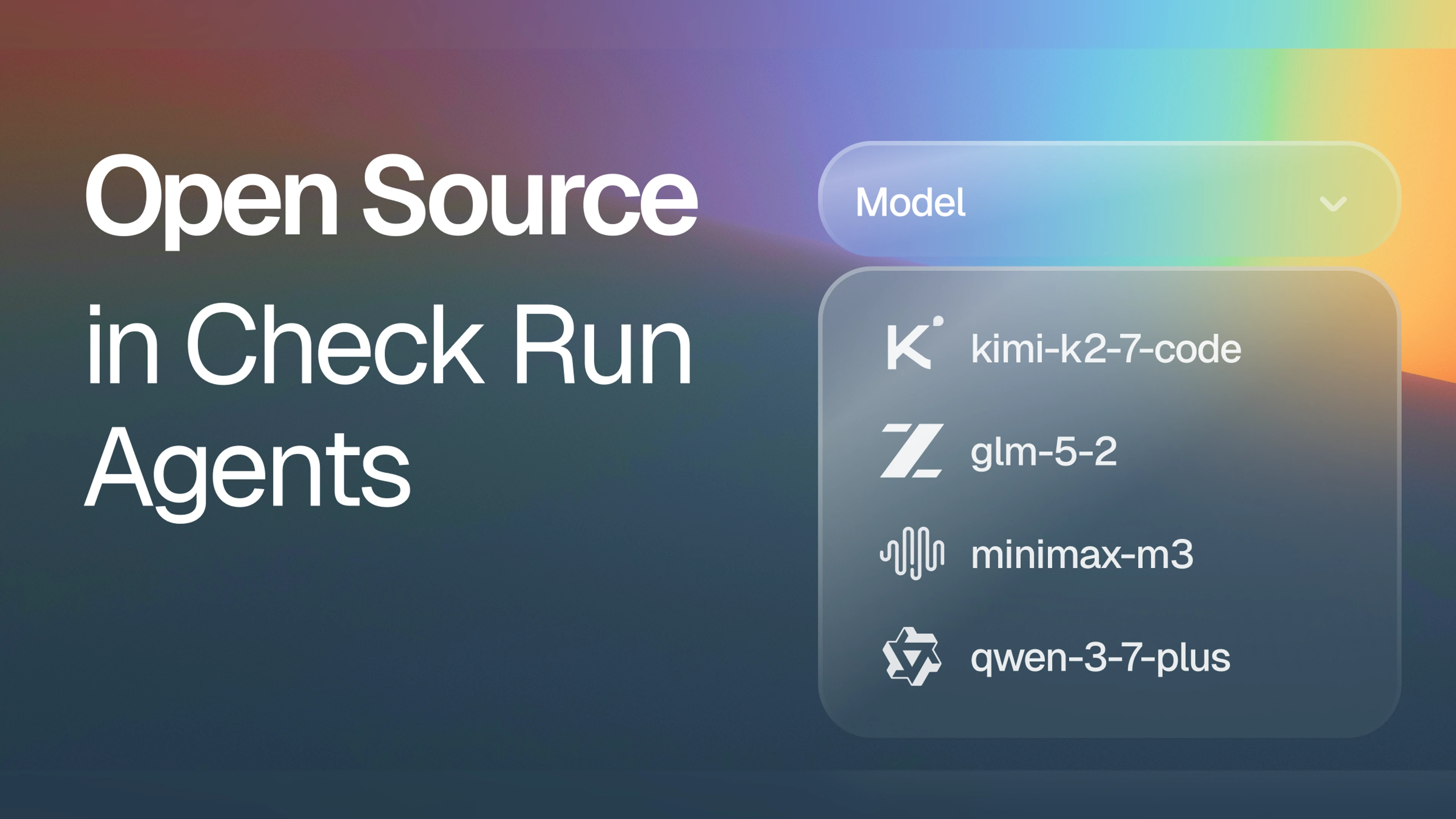
The July 16, 2026 launch introduced the models listed below. This is the launch list; use the supported models and pricing documentation for the current selection:
kimi-k2-7-codeglm-5-2minimax-m3qwen-3-7-plus
Check Run Agents have become a popular way for teams to encode their own code review workflows into custom agents that run on every PR.
At the same time, the open source model ecosystem has reached an inflection point. There are now exceptional OSS models that are competitive with frontier models across many coding and reasoning tasks, each with their own tradeoffs around cost, latency, context window, and performance.
We think giving customers access to this ecosystem is especially important because many teams have built extensive suites of Check Run Agents that execute on every PR. At that scale, inference costs can become substantial.
If an open source model can deliver the same outcome for a particular agent as a frontier model, you should be able to make that tradeoff yourself.
Choose the model that's right for each agent. See our docs for the full list of supported models and pricing.

Which open-weight models are good at code review?
GLM, Kimi and DeepSeek are open-weight candidates to compare on MacroscopeBench; choose a model configuration by precision, recall, severity and cost rather than model family alone. The open-weight code review guide connects the benchmark to custom PR checks, and the benchmark exposes the underlying configurations. A score for one effort level does not establish performance at another.
Use a small evaluation set with known bugs and correct changes from your own repository. Inspect whether each model finds the failure, points to evidence and avoids flagging intentional behavior. Then measure latency and the full cost of repeat runs. Weight availability does not by itself establish a deployment option, license permission, data-retention policy or provider no-training agreement.
Frequently Asked Questions
Which open-weight models are good at code review?
Start by comparing GLM, Kimi and DeepSeek configurations on MacroscopeBench, then test the candidate on your own PRs. Compare precision, recall, severity coverage, latency and cost together. Macroscope Check Run Agents let teams select a model per custom check; consult the supported models and pricing before configuring a run.
Does an open-weight model make a PR check private or free?
No. Open weights describe availability of model weights, not the hosting or billing arrangement. Confirm the license, inference provider, retention terms and deployment path separately. Hosted Macroscope Check Run Agents use Agent credits; an open-weight model does not make that usage free.