
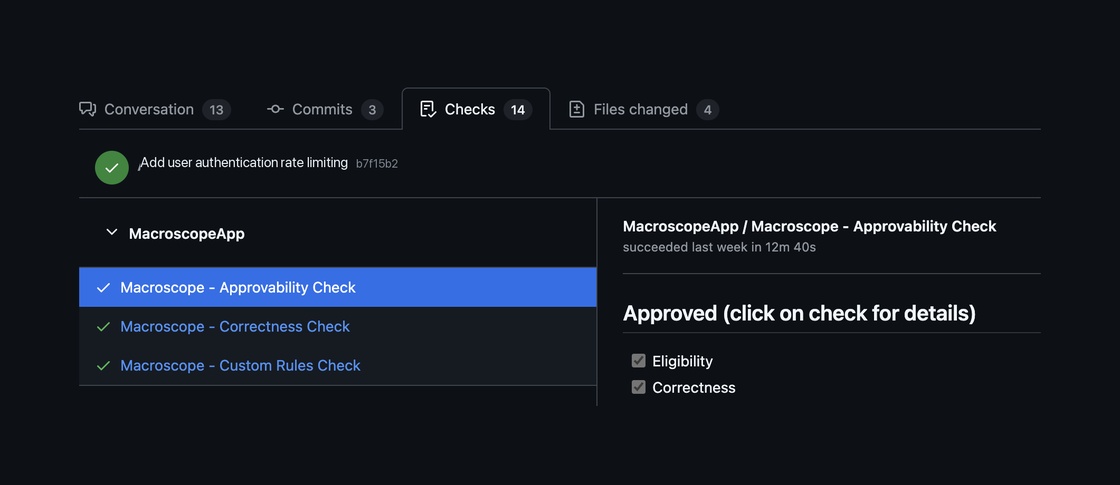
Safe PRs get approved for you
Approvability auto-approves low-risk pull requests. Across customers, 40% of PRs are auto-approved, so your team only reviews what needs a human.
Comparing CodeAnt AI for code review? Macroscope is the AI code reviewer you won't turn off. It catches real bugs, suggests the fix, auto-approves 40% of PRs across customers, and answers questions about your codebase in Slack.
Macroscope is usage-based: you pay per review, not per seat. Start with $100 in usage credit.
SOC 2 Type II compliant. Installs on GitHub in under five minutes.
Trusted by engineering teams








On Martian's Code Review Bench, Macroscope caught more of the issues developers went on to fix (recall 49.8% vs 38.0%) and was right more often when it spoke up (precision 78.5% vs 70.5%).
F1, the balance of the two: 61.0% vs 49.4%.
IndependentMeasured by Martian's open-source Code Review Bench on real pull requests, not by us.
The share of review comments that matched a change the developer actually made. Higher means fewer false alarms.
The share of the changes developers went on to make that the reviewer had flagged.
The balance of precision and recall.

MacroscopeBench, our code review benchmark, is how Fireworks' Specialized Intelligence Index scores frontier models on code review.

We publish a code review leaderboard for frontier models, scored on real bugs from open source repositories.
CodeAnt AI covers a wide surface across review, code quality and security. Macroscope goes deep on review and keeps every pull request moving: real bugs, your own rules, and auto-approval for the safe ones.
AI review sits alongside a wider set of code quality and security capabilities.
AI code review on every pull request, built to act on what it finds.
Keep the security and code quality tooling you already trust. Macroscope installs as a GitHub App and adds the review on top.
Install the GitHub App and Macroscope starts on your next pull request. Setup takes under five minutes.
Approvability auto-approves low-risk pull requests. Across customers, 40% of PRs are auto-approved, so your team only reviews what needs a human.
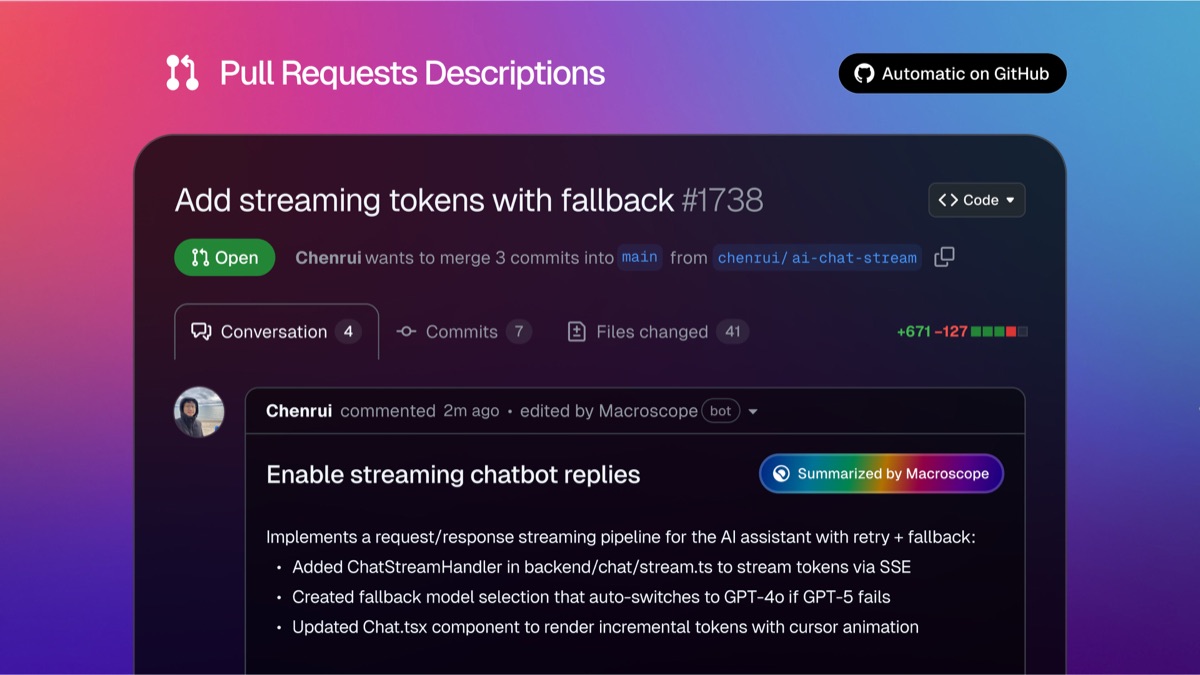
Every pull request gets a clear summary of what changed and why, written into the description automatically.
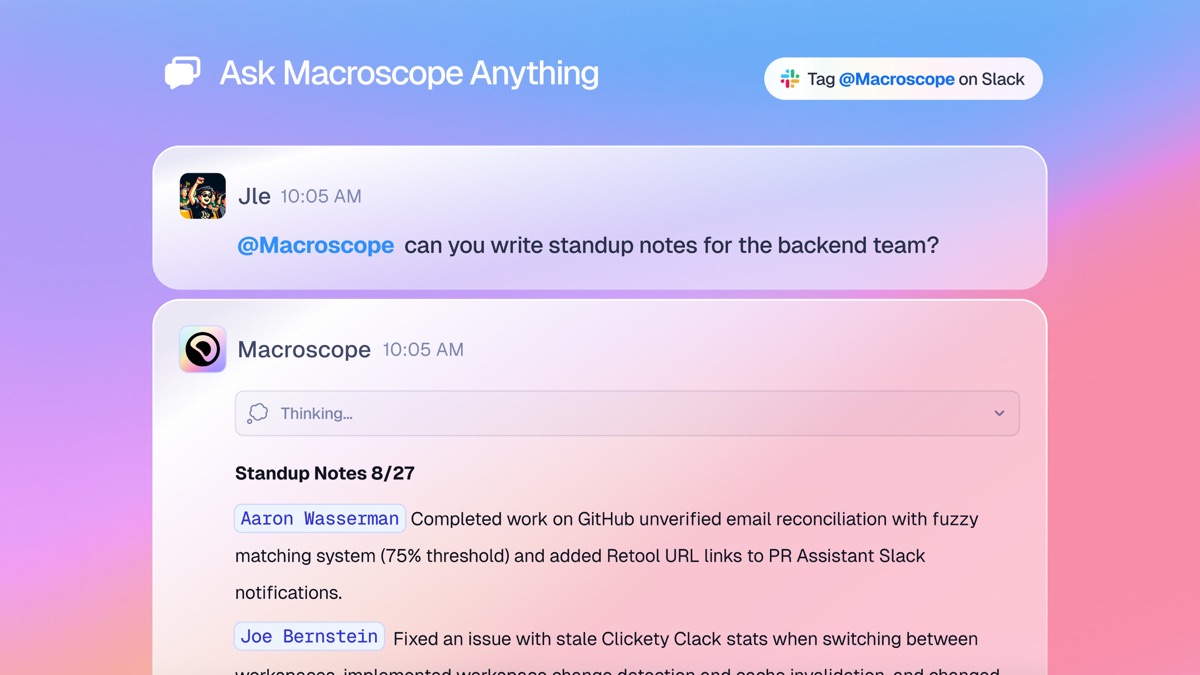
Mention @Macroscope in Slack and get answers grounded in your code, PRs and git history.







Add Macroscope next to the tools you already pay for without a per-developer line item. You pay for the code you review, and you set the ceiling.
$0.05 per KB of diff reviewed, with a 10 KB minimum per review. The average review costs about $0.95.
No sales call and nothing to migrate. Macroscope starts on the next pull request you open.
Choose your repositories. Setup takes under five minutes, and you do not need to remove CodeAnt AI first.
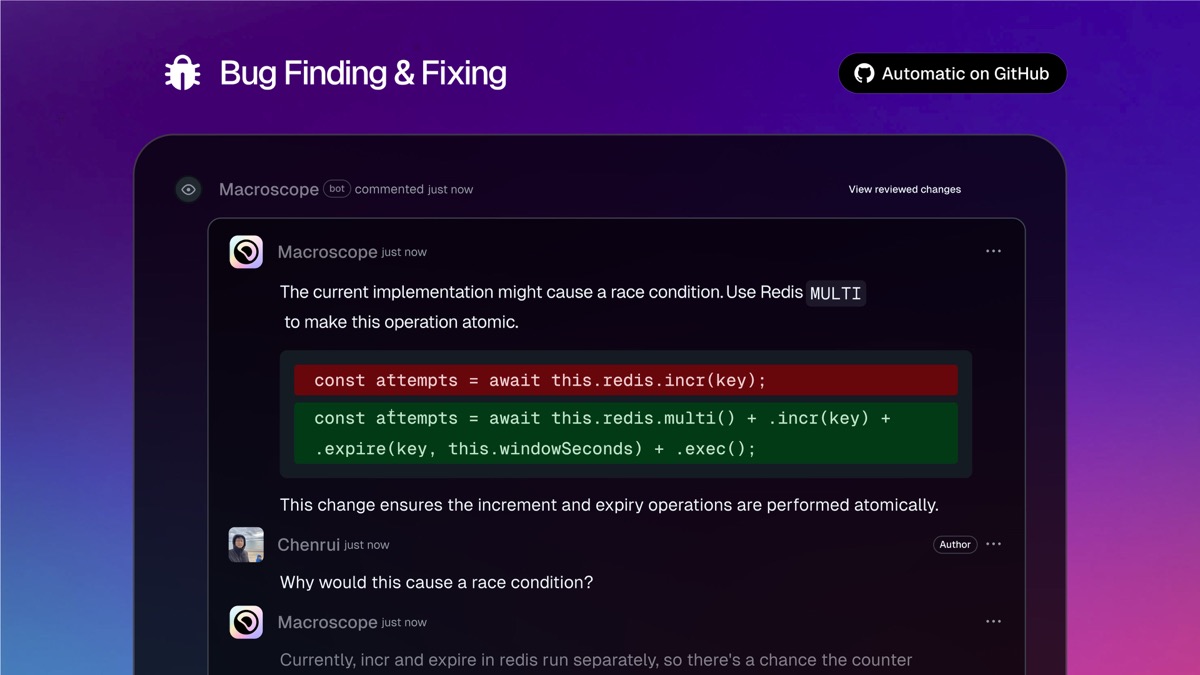
Comments land inline on the pull request, with a suggested fix. Low-risk PRs can be auto-approved.
Then $0.05 per KB of diff reviewed, with no seat fees. Set a monthly spend limit whenever you like.
SOC 2 Type II compliant. Read our Trust Center, Privacy Policy and Terms of Service.
Keeping your data secure is of paramount importance to us. We have rigorous technical, operational and contractual safeguards in place to protect customer data.
Visit our Trust Center to request copies of our audited documentation.

All customer data is encrypted at rest and in transit.

Customer Code is architecturally isolated and secured by design. None of our employees can access your source code.

Macroscope does not train models using your source code, and our agreements with model providers ensure they do not train using your IP.
If pull request review is the job you are hiring for, Macroscope is built around exactly that. It reviews every pull request on GitHub, flags correctness bugs and suggests the fix, auto-approves low-risk pull requests with Approvability (around 40% across customers), and enforces your own rules through Check Run Agents. Pricing is usage-based at $0.05 per KB reviewed with no per-seat fee.
On the independent Martian Code Review Bench (read 7 October 2026), Macroscope scored higher than CodeAnt AI on all three headline metrics: precision 78.5% vs 70.5%, recall 49.8% vs 38.0%, and F1 61.0% vs 49.4%. Precision is the share of review comments that matched a change the developer actually made.
Yes. Macroscope installs as a GitHub App and reviews pull requests without replacing any scanner or security tool you already run. A common setup is to keep your security and code quality tooling and add Macroscope for the review itself. New workspaces start with $100 in usage credit.
Run both on the same pull requests for a week and compare the comments: which ones point at real bugs, how much is noise, and how many pull requests could have merged without waiting on a human. Setup takes under five minutes.
No. Macroscope integrates directly into your existing workflow and is designed to complement your existing tools. Once installed, Macroscope will automatically start summarizing PRs and leaving code review comments directly on GitHub.
Yes. Product managers, engineering managers, customer success teams, and executives use Macroscope to stay informed about what's changing in their product and codebase.
All of them. Macroscope reviews pull requests in every language, so there is no list to check your stack against. Commit and PR summaries, project tracking, and productivity insights work across every language too.
Macroscope is used by startups and enterprise engineering teams alike, from 5-person teams to 100+ engineer orgs.
Teams can get up and running in under 5 minutes. Install the GitHub app, connect Slack (optional), and you're ready! New customers get $100 in usage credit so you can get going right away. It's usage-based, so you only pay for the code you review. Macroscope immediately begins analyzing open PRs and backfilling recent code activity.
Yes. Macroscope installs as a GitHub app and reviews every pull request automatically, posting comments inline the moment a PR opens. Unlike a rules-based bot, it builds a graph of your entire codebase first, so it comments on bugs that matter instead of pattern-matching on style.
Macroscope is usage-based and averages around $0.95 per review. You pay per pull request reviewed, not per developer seat, so your cost tracks how much code you actually ship rather than how many people are on the team. New teams start with $100 in usage credit.
Linters and static analysis match patterns inside a single file. Macroscope builds a graph-based representation of your whole codebase using Abstract Syntax Trees, so it catches bugs that span files, functions and services, which is the class of bug a linter structurally cannot see. It also means far fewer false positives, because it can tell whether a suspicious line is actually reachable.
Yes, and it is the main reason teams adopt it. When Copilot, Cursor or a coding agent writes most of a pull request, the bottleneck moves from writing code to reviewing it. Macroscope reviews AI-written PRs the same way it reviews human ones, and around 40% of pull requests end up auto-approved so engineers only look at what genuinely needs a human.
Both, depending on how you use it. As an AI code review platform it reviews every pull request, writes PR summaries, and gives engineering leaders a view of what is shipping. Most teams start with automated PR review on GitHub and adopt the rest later.
Traditional code quality tools score a snapshot of your repository against fixed rules, which is useful for tracking coverage and style but rarely catches a real bug. AI-powered code review reasons about the change itself, in the context of the codebase around it, and tells you what will break. Teams generally keep both: one for hygiene, one for correctness.
Not yet. Macroscope currently supports GitHub, and GitLab and Bitbucket are on the roadmap. If you are on either one, book a demo and we will let you know when support lands.
Join teams building with Macroscope to catch more bugs and merge PRs faster than ever. Simple usage-based pricing. No seat fees, no surprises.